
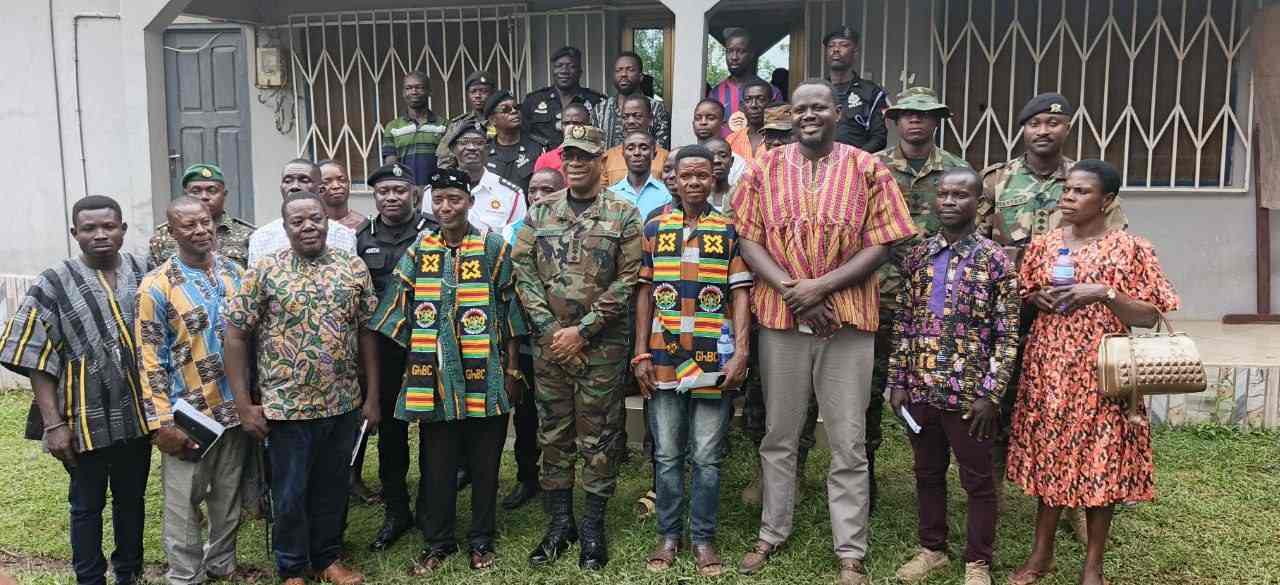
The Commissioner-General of the Ghana Boundary Commission (GhBC), Major General Anthony Ntem, has called on residents of border communities in the Nkwanta South Municipality to remain vigilant and continue cooperating with the Commission as it works to secure and develop Ghana's frontier areas.
The Commissioner-General made the call during a working visit to Nkwanta South on Wednesday, July 29, 2026, as part of a five-day operational assessment of the Ghana–Togo international boundary. The tour, which began in the Kadjebi District, also took the delegation through Nkwanta South Municipality and Nkwanta North District. In Nkwanta South, Major General Ntem was received by the Municipal Chief Executive, Hon. Joseph Antwi, and engaged traditional authorities, Assembly officials, and residents of Dadiase, Kue, and Chillinga.

Speaking to the gathering, Major General Ntem explained that the GhBC is mandated by an Act of Parliament, Act 1123 (2024), to manage the country's international boundaries — covering land, maritime, and airspace boundaries — with a core responsibility to demarcate and reaffirm these boundaries where necessary. He noted that many of the boundary pillars currently in place were erected during the colonial era, and that the Commission periodically tours the country to verify their condition.
"Some of the markers are not tall enough, some have been removed, either intentionally or accidentally as a result of human activities," he said, adding that the Commission plans to replace ageing pillars with modern, taller markers visible from a distance to prevent confusion or disputes with neighbouring countries.
Beyond the technical work of boundary demarcation, Major General Ntem said the Commission places strong emphasis on the wellbeing of communities living along the border. He explained that assessment teams routinely verify whether such communities are living peacefully — both internally and with communities across the boundary — and that any disputes are addressed in liaison with counterpart agencies on the other side.

The Commissioner-General also used the visit to assess development needs in the area, citing poor network access, road infrastructure, and water supply as recurring challenges raised by residents. He assured the gathering that findings from the tour would be compiled into a detailed report and forwarded to the relevant ministries, and disclosed that the Commission works with development partners willing to support border communities with facilities such as CHPS compounds, potable water systems, and educational infrastructure.
"We do this as a Commission because we do not want anyone to take advantage of your developmental needs situation by planting miscreants among you," he cautioned, urging residents to remain united and resistant to outside influences that could threaten peace along the border.

Major General Ntem further encouraged residents to strengthen cooperation with communities on the Togolese side of the border, noting that many border communities share common ancestry, separated only by political boundaries, and often depend on shared farmland and markets across the frontier.
The Commissioner-General commended the resilience and patriotism of the border residents and reaffirmed the GhBC's commitment to strengthening boundary governance and integrating border communities into Ghana's national boundary management framework.
